
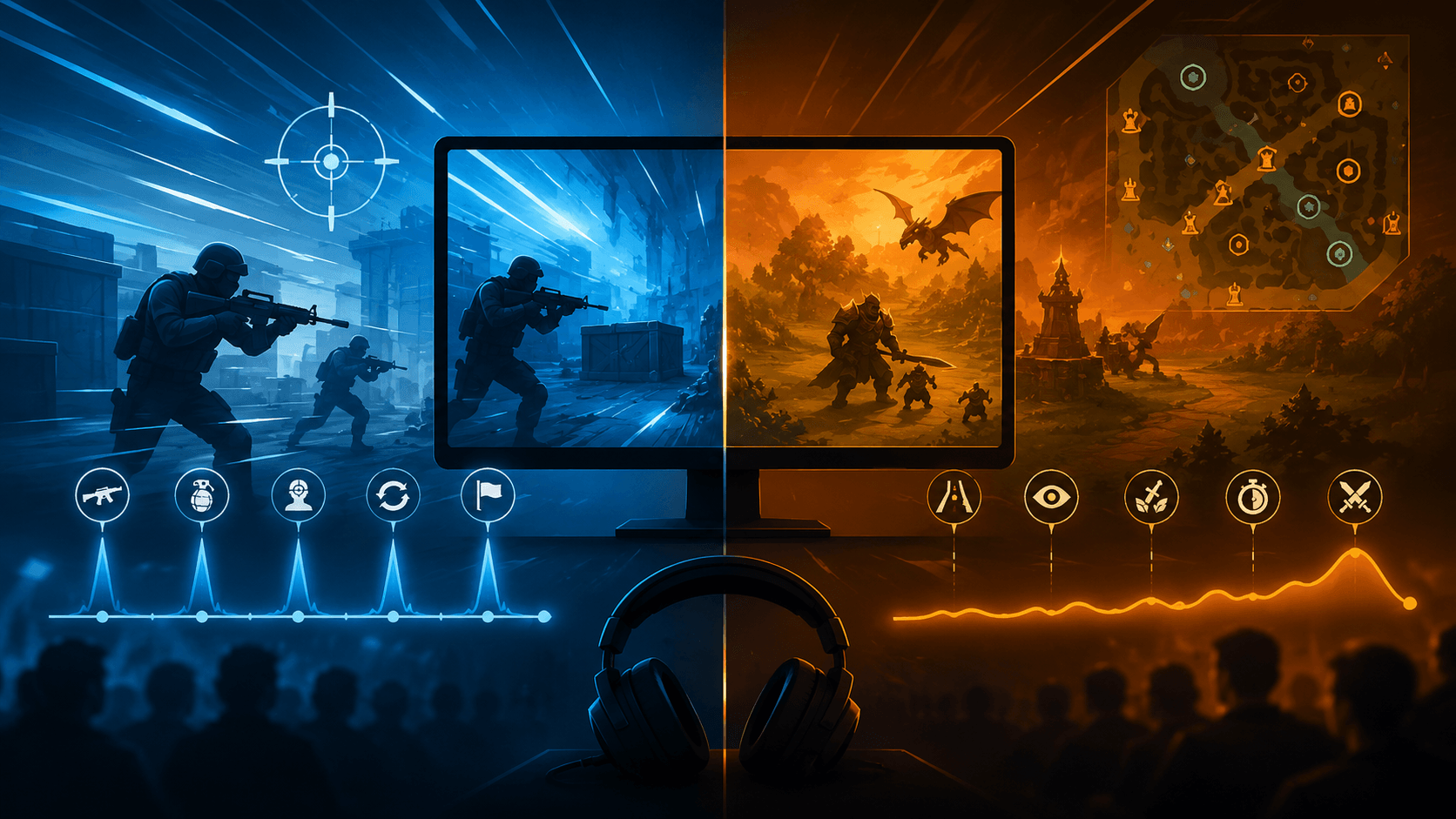
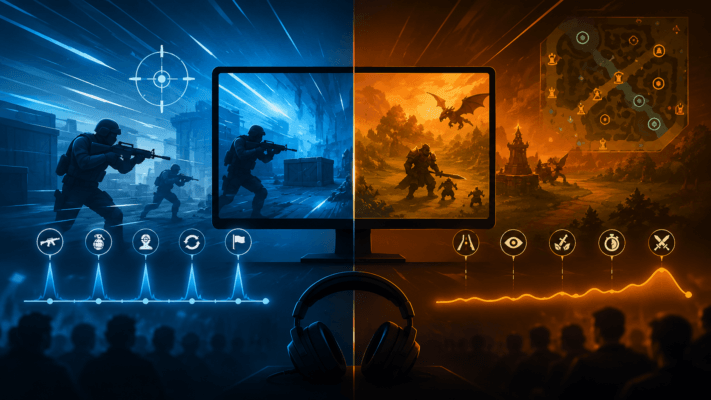
FPS and MOBA esports ask viewers to watch the games in different ways. Counter-Strike 2 and Valorant focus on the tension around corners, utility, retakes, and sudden duels. Dota 2 and League of Legends are more focused on lanes, map control, cooldowns, and objective timers. A new viewer may understand both as team games, but the screen teaches them at different speeds.
A 2021 open-access study on esports spectatorship found that viewing motives can shift by game genre and live-streaming type, which is useful information for creators. Pacing is built by the match and by how audiences learn to follow it through game genre and stream format.
Where Genre Changes the Clock
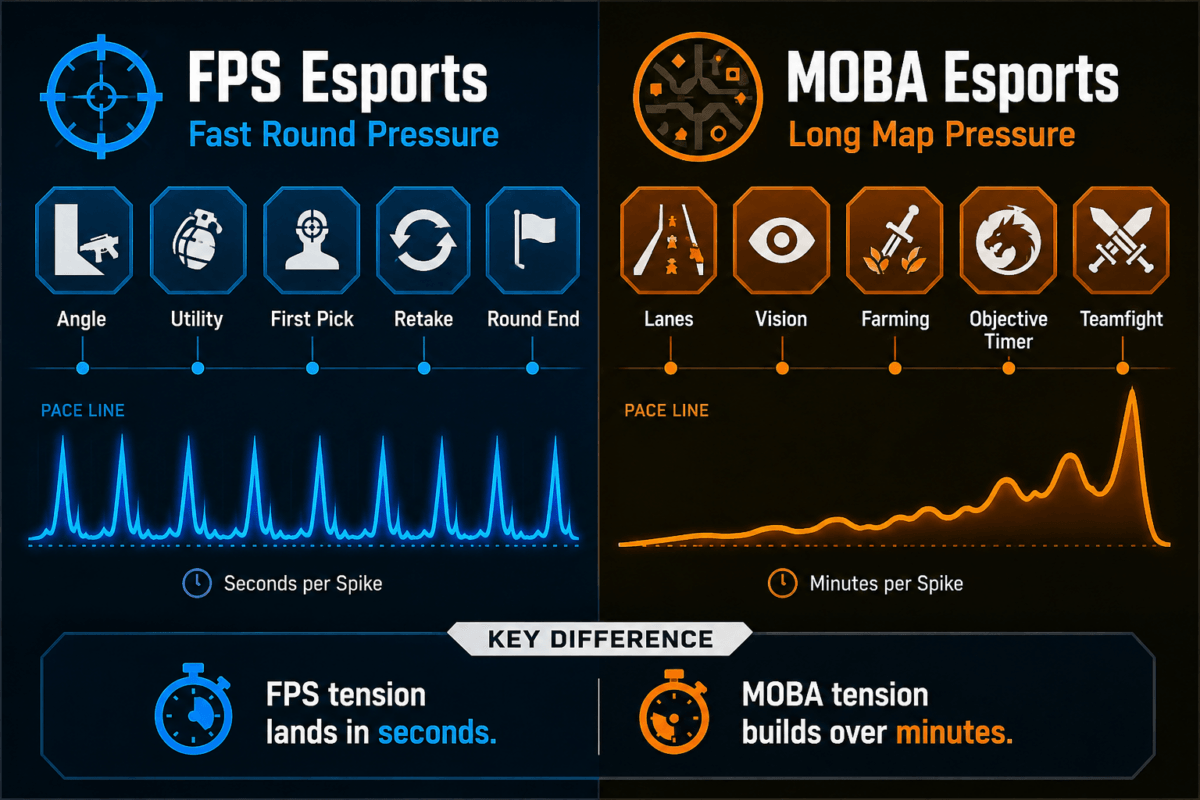
The cleanest way to compare FPS and MOBA esports is to stop treating them as broad genre labels and look at how real matches create pressure. Tactical shooters are built around short rounds, fixed sites, visible entry points, and small windows where one mistake can decide the outcome. MOBAs stretch that pressure across a larger map. A team can look calm on-screen while quietly losing control through vision gaps, lane pressure, item timing, or a poorly timed objective setup.
That difference becomes clearer when matches are viewed through an esports sportsbook setting, because the available event lines often reflect the structure of the game being played. For readers comparing how these titles appear in live and upcoming competitions, understanding how to bet on esports at Bovada can improve your overall grasp of the games in this space and how matches evolve over time. Bovada covers games such as Counter-Strike 2, Dota 2, League of Legends, Valorant, Call of Duty, and Rainbow Six, with match lines, futures, and common markets, such as Win, Spread, and Total, appearing where they apply.
The value here is not just seeing that the games are listed together. It is seeing why they cannot be read the same way. CS2 and Valorant often make tension visible through round count, site control, economy, utility use, and the first clean pick. Dota 2 and League of Legends usually ask the viewer to read a longer chain of pressure, where a fight may be decided by map control or objective timing before the players actually collide.
A useful follow-up is the guide to the most popular esports for betting, which keeps the same comparison grounded in recognizable titles. Its examples, including CS2, Dota 2, League of Legends, Valorant, and Call of Duty, show why FPS and MOBA viewing habits do not overlap perfectly. Tactical shooters reward quick recognition of round swings. MOBAs reward patience, map awareness, and the ability to notice pressure before the teamfight begins.
FPS Esports Reward Instant Reading
In an FPS broadcast, the camera usually has a clear job: show the next point of contact. A player holds an angle. Another clears it. Utility blocks a doorway or forces a defender out of position. The bomb or spike adds a clock, so even a quiet round feels like it is tightening.
That makes FPS esports particularly suitable for short clips and more viewer-friendly. A clutch can be understood in seconds because the threat is visible. One player is isolated. The crowd knows the remaining ammo, health, time, and angle. Economy management changes how aggressive a team can be. Utility timing decides whether a retake is realistic. A rotation made 10 seconds too late can make a site collapse. Streamers covering FPS titles do well when they call those small details before the duel, not after it. The viewer then feels the shot land because the setup already made sense.
This is also true if you’re looking at free games to stream on Twitch; it’s helpful to understand what kind of viewers they might attract, how they are best expressed, and some of the context around them before you begin. Valorant and Counter-Strike 2 give streamers quick swings, clear rounds, and highlight-friendly endings. MOBAs ask more from the commentator, but they also give more room for explanation between fights.
MOBAs Make Viewers Track Pressure
MOBAs rarely put the whole story in the center of the screen. A kill in bottom lane may matter less than a ward line around the next objective. A teamfight may look even until one side reveals a level advantage, a completed item, or an ultimate that the other team cannot answer.
League of Legends is often easier for new viewers than Dota 2 because its broadcast rhythm tends to point toward dragons, Baron, towers, and lane assignments in a compact way. Dota 2 can feel stranger at first because buybacks, teleport scrolls, smoke moves, Roshan control, and hero power spikes pull attention across the map. Once those ideas click, the match becomes less chaotic. Viewers begin to see pressure before the fight begins.
For streamers, MOBA commentary needs a little runway. The best explanation often happens 30 seconds before the highlight. Who controls vision? Which cooldown is missing? Which side is happy to wait? Which lane is forcing someone to respond? Without that context, the final fight can look like noise. With it, the viewer sees why one team walked into a losing position.
What Streamers Should Take From Both
FPS and MOBA streams reward different habits. Match your commentary to the game’s clock. In Valorant, the viewer needs to know who has space, utility, and time. In CS2, the economy and first pick often explain the round’s direction. In League of Legends, objective timers and vision shape the next fight. In Dota 2, power spikes and map movement can matter before the scoreboard changes.
The strongest Twitch creators do not treat pace as background. They teach viewers what to watch next. That may be a doorway, a minimap, a cooldown, a retake, a jungle entrance, or a wave crashing at the wrong time. When the audience learns the clock of the genre, the match starts speaking earlier, a viewing habit that lines up with Frontiers research connecting esports watching intention with skill improvement, entertainment, and friends bonding.