

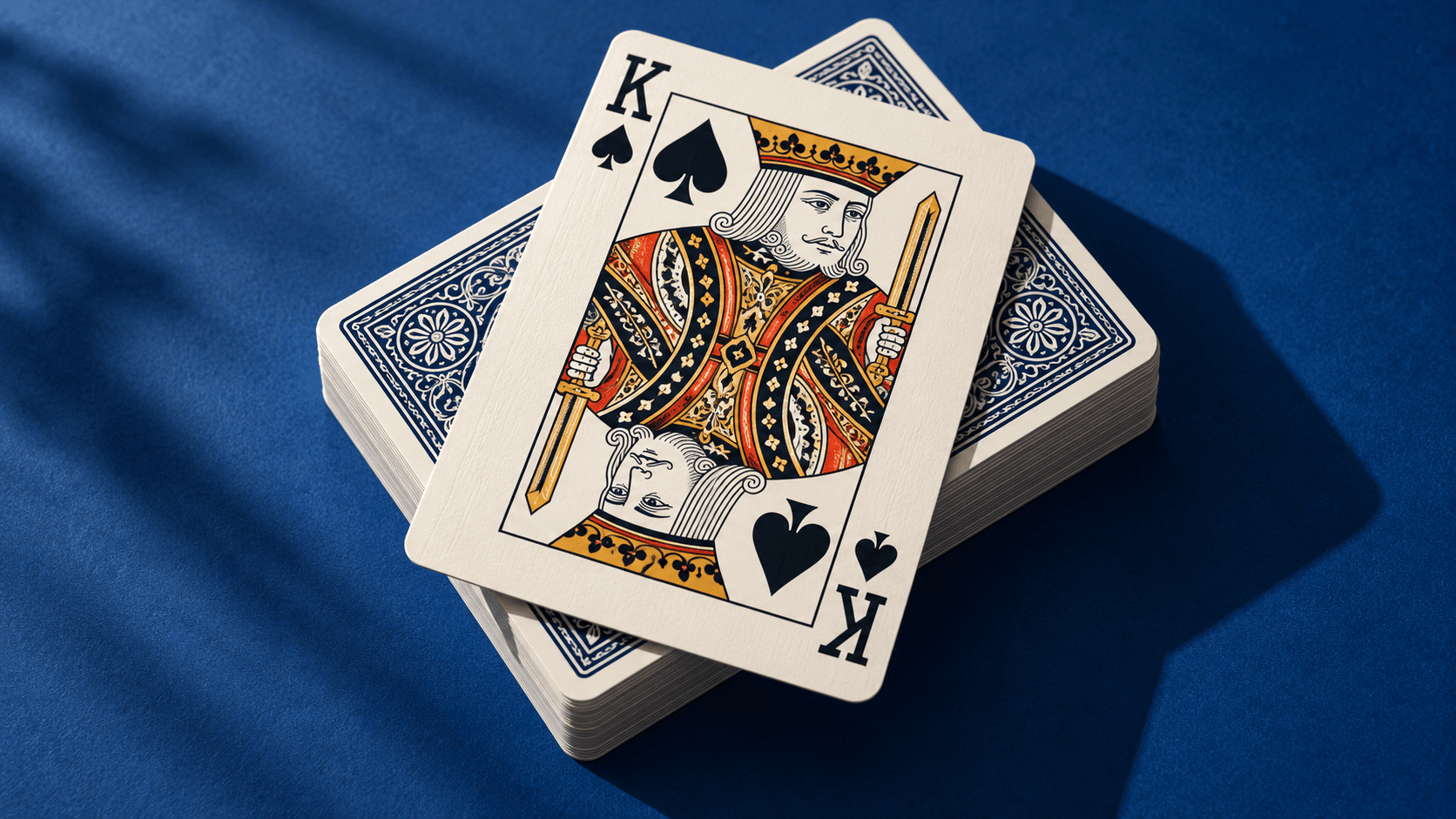
A king counts as 10 in blackjack and zero in baccarat. In video poker, its rank can help form a pair, while its suit can contribute to a flush. The card has not changed, but the information that defines a useful hand has. Blackjack adds values, baccarat keeps the final digit of a total, and video poker recognizes combinations.
Those systems draw on different properties of familiar playing cards. Researcher Simon Huber’s study of playing cards describes how simple operations, including drawing, holding, and turning cards over, combine into different games. The same flexibility applies to scoring: a number, a matching rank, or a shared suit can become significant when the rules give it a function.
The distinction runs through the card games at an online casino in the US. Classic Blackjack, Classic Baccarat, and Jacks or Better use familiar card symbols, yet each asks a different question about the hand. Blackjack compares the player’s total with the dealer’s. Baccarat compares two totals after reducing them to a single digit. Jacks or Better evaluates the final five cards against its listed hand categories, without an opposing player’s hand.
Blackjack Adds Values Toward 21
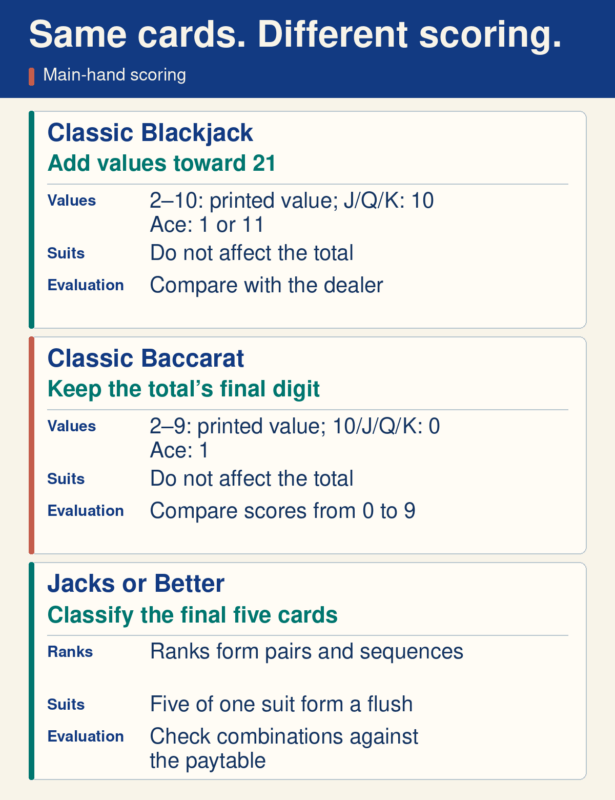
In Classic Blackjack, cards numbered 2 through 10 retain their printed values. Jacks, queens, and kings each count as 10. An ace counts as 1 or 11, using the higher value when that does not take the total over 21. A hand with an ace counted as 11 is called soft because that ace can count as 1 instead.
The player receives an initial two-card hand and can request another card by hitting, or keep the current hand by standing. The aim is to finish ahead of the dealer without exceeding 21. Going over 21 is a bust, which ends the player’s hand immediately; a later dealer bust does not restore it.
A blackjack has a narrower meaning than a total of 21. It is an ace and a ten-value card in the initial two-card deal. Reaching 21 with additional cards produces a total of 21 rather than that initial blackjack. When neither hand is a blackjack or a bust, equal totals produce a push, the game’s term for a tie.
Suits do not affect the main hand’s total. Matching hearts or spades add no scoring category, and face cards share a value despite their different ranks. The relevant information is the total, how any ace is counted, and the hand’s status against the dealer.
Baccarat Keeps the Final Digit
Classic Baccarat also adds card values, but its arithmetic works differently. Aces count as 1, cards numbered 2 through 9 retain their values, and tens, jacks, queens, and kings count as zero. After adding the cards, only the final digit remains. Every completed hand therefore has a score from 0 to 9.
The two hands are labeled Player and Banker. Those labels identify the hands being compared, rather than assigning the person playing to one particular hand. A selection can concern either hand or a tie. The hand closer to 9 has the higher score, while equal totals produce a tie.
Additional cards follow prescribed drawing rules. There is no blackjack-style decision to hit or stand after inspecting the cards. Scoring and drawing remain separate parts of the game: the final-digit rule determines the value, while the drawing procedure determines whether the hand receives another card.
Suits again have no scoring role. A pair is simply two cards whose baccarat values contribute to the total, without becoming a separate ranked combination.
Video Poker Reads Ranks, Sequences, and Suits
Jacks or Better starts with five cards. The player can hold any, all, or none of them and replaces the discarded cards in one draw. The resulting five-card hand is then evaluated against the game’s paytable, which lists qualifying combinations.
Here, adding the printed values would miss the game’s structure. A pair consists of two cards of the same rank. Three of a kind and four of a kind also depend on matching ranks. A full house combines three matching cards with a pair of another rank.
A straight uses five consecutive ranks, while a flush uses five cards of the same suit. A straight flush combines both properties. These categories explain why suits become relevant, even though they do not contribute points.
The categories also follow a fixed order. A flush ranks above a straight, and a full house ranks above a flush. A royal flush is the sequence from 10 through ace in one suit, occupying the top category in this version.
The name Jacks or Better identifies the minimum qualifying pair: jacks, queens, kings, or aces. Lower pairs do not qualify by themselves. Unlike player-versus-player poker, the hand does not need to outrank another person’s cards. Its category is assessed against the game’s own listed requirements.
The Rules Give Each Card a Role
Game designers can work with those familiar objects while changing the rules around them. Discussing the development of Kessel Sabacc, Game Developer reported that the Star Wars Outlaws team prototyped its fictional card game with ordinary playing cards, adjusting rules during testing. The physical deck supplied the pieces; the rules determined what players could do with them.
A king retains its printed rank in all three games, but the scoring rule decides whether it contributes ten, contributes zero, or helps complete a qualifying combination. Its role comes from the game, rather than the picture on the card.